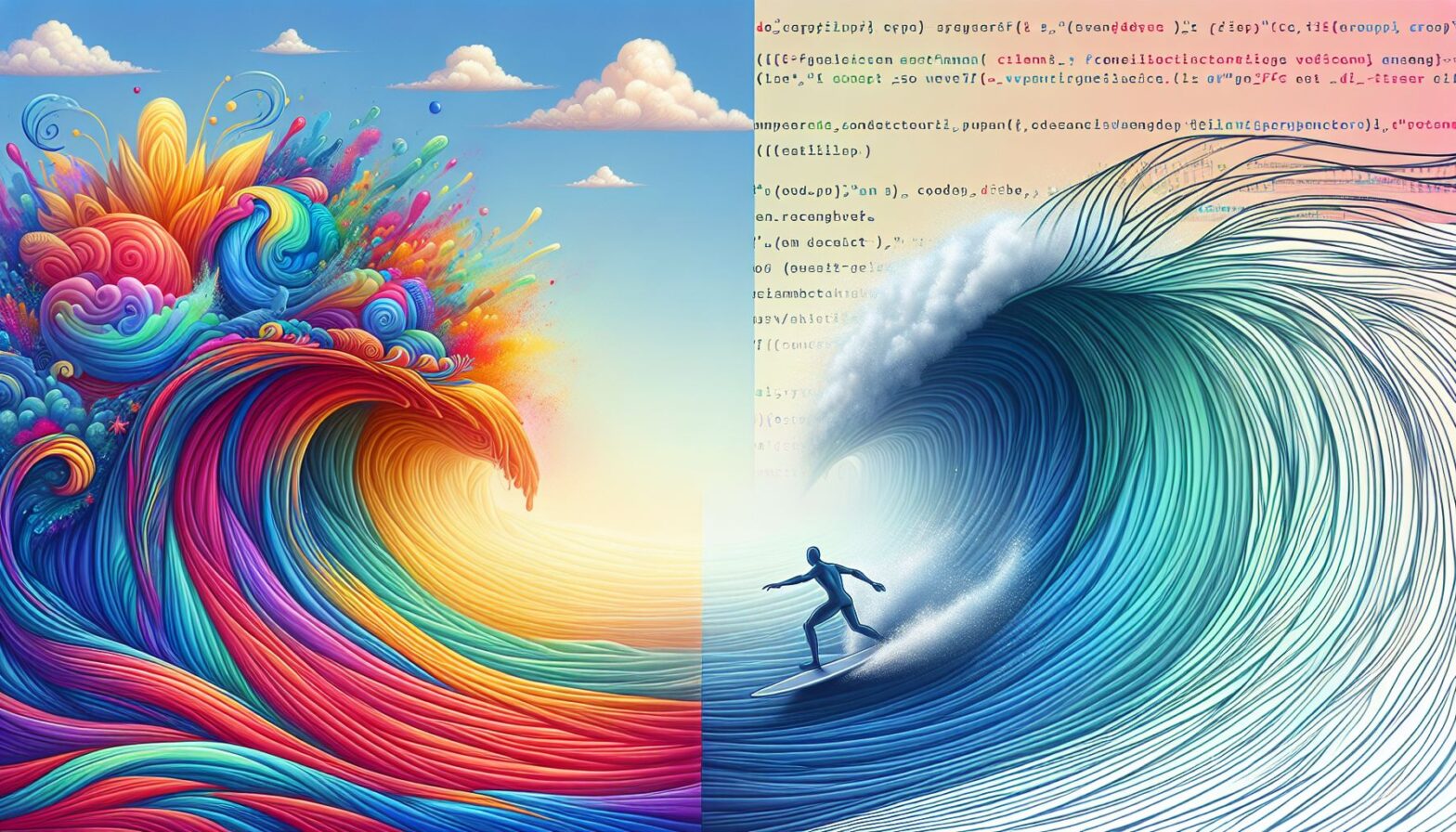
Hello, fellow tech enthusiasts! I’m here, coffee in hand, ready to talk about one of the most exciting crossroads of technology and art we’re seeing today: Artificial Intelligence in the creative arts. Whether you’re an artist looking to expand your digital toolkit or a tech junkie itching for a new gadget to tinker with, there’s a lot to get excited about.
Why Paint When You Can Code?
Gone are the days when coding was just about solving tedious math equations or building yet another weather app. These days, Artificial Intelligence has taken a liking to paintbrushes, musical notes, and even novels! Remember when computers used to struggle with giving us a reliable spellchecker? Now they’re pumping out symphonies and copying Picasso. I know, it’s as if someone just handed Terminator a beret and a sketchbook.
A Brief Jaunt Down Memory Lane
I remember when I first got my hands on an AI tool that promised to generate artwork. This was a few years back when I was still wrapping my head around neural networks and deep learning algorithms. I set it up, hit go, and watched as my computer churned for what seemed like forever. The outcome? An abstract mash-up of colors that looked like something a dog might dream up if it ate a box of crayons. But it was love at first byte.
Fast forward to today, where tools like DALL-E by OpenAI and DeepArt aren’t just generating art—they’re redefining creativity. These models have grown up, and now they don’t just mimic human art, they enhance it.
The Big Players in AI Art
DALL-E’s Brush
DALL-E, from the wizards at OpenAI, doesn’t just create random pixels on a screen. It can generate images from text prompts, mixing and matching styles like a caffeinated DJ at an art gallery. What’s really cool is that you can give it something abstract, like “an octopus playing a piano on top of Mount Everest during a lightning storm,” and voila, an artistic masterpiece appears!
Google’s DeepDream: A Trippy Journey
If you’re into surrealism, DeepDream might just be your thing. Originally a vision research project, it works on your images to produce everything from trippy landscapes to kaleidoscopic horror shows that’ll give Dali a run for his money. It’s not for everyone—I suppose it takes a special kind of person to appreciate a dog-face-infused sky—but it’s definitely an example of AI’s potential for pushing artistic boundaries.
AIVA: The Beethoven of Bits
Let’s not forget about music. AIVA (Artificial Intelligence Virtual Artist) composes original music, trained on the works of great classical composers. You give it a genre, mood, and style, and AIVA whips up a composition that could very easily sneak into a concert hall unnoticed. Classical purists might raise an eyebrow, but can they argue with hitting “play” and being swept away without lifting a baton?
The Implications of AI in Creative Arts
A Collaborative Tool, Not a Replacement
Let’s address the elephant in the room: will AI replace human artists? The short answer: no. AI is a tool—a sophisticated one, sure, but still just a tool. Artists can use it to explore new styles, generate ideas, and even create interactive installations, but it won’t replace the unique human touch that turns good art into transformative experience. Think of AI as an incredibly talented assistant, always ready with a cup of java or a fresh canvas.
Accessibility and Democratization
AI is also democratizing art. You don’t need years of training or an art degree to produce something beautiful. Kids in small towns with just a laptop and curiosity can now produce pieces on par with traditionally trained artists in urban centers. That’s pretty cool if you ask me.
The Challenges: Not Just a Walk in the (AI-Generated) Park
Ethical Quandaries
Ethical concerns do exist. Who owns a piece of art created by AI? The coder? The user? The machine? Figuring this out is a bit like untangling a ball of yarn tossed around by a few dozen cats. And what about biases encoded in these models? AI learns from existing data, so if that data is biased (and spoiler alert: a lot of it is), then its creations will be too.
Quality Control
There’s also the question of quality. Just because an AI can generate 100 pieces in the time it takes most of us to make a cup of coffee doesn’t mean each piece will be a Van Gogh. Or even a Velvet Elvis. More often than not, you get digital noise before you hit a note of genius—a frustrating, albeit necessary, growing pain.
Looking to the Future: Endless Horizons
We’re really just scratching the surface of what’s possible with AI in the creative arts. Machine learning researchers and artists are already experimenting with virtual reality (VR) and augmented reality (AR), creating immersive environments where you can “walk” into a painting or manipulate a digital sculpture with the flick of a wrist.
Imagine a future where AI integrates directly into live performances, swapping out backdrops or modifying the music based on audience reactions in real-time. Or artists creating on-demand art installations, tailored instantly to fit the ambience of a space or the mood of a crowd. The potential is vast, and I won’t lie, it’s a bit head-spinning.
So, dear reader, whether you’re an artist, a coder, or simply someone who likes to push buttons to see what happens, the future of AI in creative arts is as exciting as it is unpredictable. Embrace the chaos—after all, isn’t unpredictability just another word for creativity? I, for one, am thrilled to be riding this wave and can’t wait to see where the current takes us next!