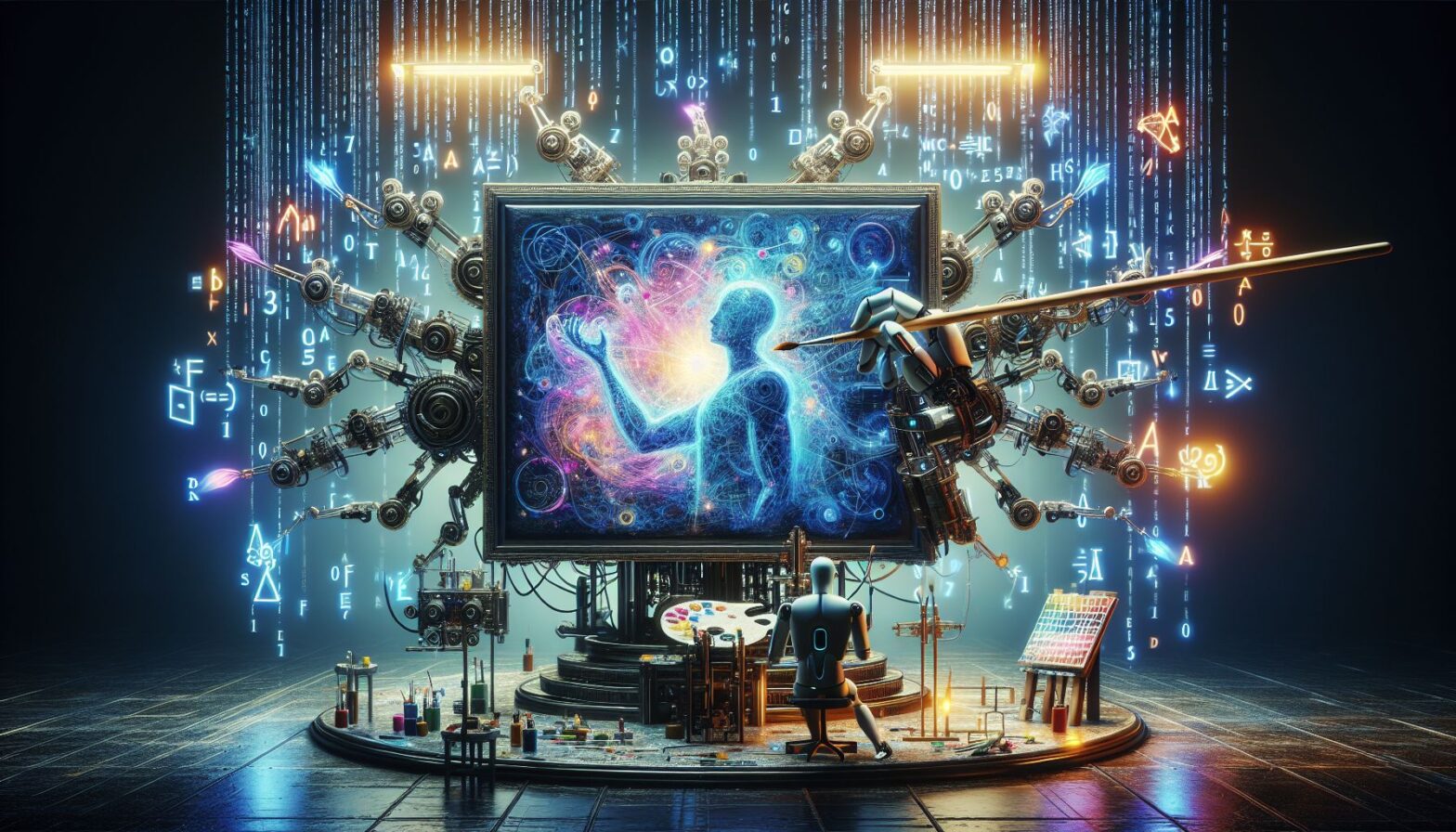
Hello, tech enthusiasts! When we think of artificial intelligence, images of cold, calculating machinery often come to mind, whirring away in sterile laboratories and hulking data centers. Today, however, I’m jumping into something a little more colorful and artistic—how AI is redefining creativity and art. Let’s see how far we’ve come and where this wild ride might take us.
Introduction to AI in Creative Fields
Gone are the days when creativity was only a human thing. In the age of artificial intelligence, machines aren’t just processors and lines of code, but muses, collaborators, and sometimes, the artists themselves. From digital paintings and music to literature, AI has become a valuable tool and partner in the creative process. But what does this mean for artists and the art industry as a whole?
Computer-generated art started back in the 1960s, but recent advances in machine learning have pushed AI into the spotlight of creative production. With generative adversarial networks (GANs), neural networks, and natural language processing (NLP), AI-generated art isn’t just a novelty anymore. It’s a reality that’s gaining traction across industries, galleries, and social media feeds.
The Marvel of Machine Learning in Art Production
A New Kind of Muse: AI as Co-Creator
AI has grown from playing a supporting role in the creative process to being a real collaborator. Thanks to GANs, AI can now create images, sounds, and text that often surpass human capabilities in complexity. This is wild when you consider that the building blocks—data and algorithms—are basically math.
One of the most famous algorithms, DeepArt, shows off what neural networks can do when generating artwork that blends different styles. Think of the algorithm as a virtual brush that understands Picasso just as well as it does Van Gogh. It’s not just creating a mashup of styles; it’s generating entirely new artistic expressions.
Text as a Canvas: AI in Literature
AI’s role in the literary world has been pretty revolutionary. GPT-3, one of the most advanced NLP models, can’t craft novels yet, but it’s surprisingly good at generating poetic prose, catchy headlines, or even drafting emails! All it needs is a prompt, and it churns out narratives with remarkable coherency.
Stuck with writer’s block? AI can generate plot ideas, help with editing, or even mimic the writing style of your favorite author. The creative struggle gets easier, allowing humans to focus on refining their unique spark rather than the grunt work.
Audio Adventures: The Role of AI in Music
For AI, music is a complex mix of rhythm, melody, harmony, and lyrics. Algorithms trained on this musical data can compose original scores, suggest chord progressions, or even mimic the compositional styles of composers who died centuries ago.
Platforms like AIVA (Artificial Intelligence Virtual Artist) are leading the charge, letting creators produce symphonies without formal music training. It’s like having a band that plays your tune at the click of a mouse.
The Implications: Will AI End Creativity or Amplify It?
Making Art Accessible with AI
One of the biggest advantages of AI in art and other creative fields is how it opens doors. AI tools are becoming increasingly accessible, breaking down barriers and allowing anyone with a computer to try their hand at art creation. New artists can use platforms like Runway ML, which makes powerful machine learning tools available in straightforward, easy-to-use interfaces.
This accessibility challenges the elitism that’s traditionally been part of the art world. It’s about giving everyone a chance to express themselves without years of art school training or expensive equipment.
Value Controversies: What is Art?
The big question in the age of AI art is: “What is art?” Purists argue that art is fundamentally human, born from consciousness and emotion, things machines don’t have. But others see a new form of expression—a partnership between human and machine producing art for a new era.
The commercial art industry is also changing. Works created partially or entirely by AI have sold for serious money at auctions. A perfect example would be a piece by an AI called “Edmond de Belamy,” which sold for over $400,000 at Christie’s in 2018. The buyer probably valued novelty over tradition. But does a machine with no consciousness deserve a place on the gallery wall, priced like pieces painstakingly crafted by hand over weeks or months?
Ethical Problems: Ownership and Authenticity
Who owns AI-generated content? The programmer, the user, or the machine itself? This question challenges traditional ideas of intellectual property. As AI models improve, issues around plagiarism and reliance on existing works become more pressing. AI may produce, but its “creativity” still depends heavily on datasets made from human creations.
Bridging the Gap: The Future of AI and Creativity
Enhanced Creativity: The Human-Machine Partnership
Looking ahead, virtual and augmented reality may completely transform AI-assisted creative processes. Imagine creating in a mixed reality space where an AI partner enhances your vision in real-time, a digital canvas that changes and evolves alongside you, like a constantly shifting landscape of ideas.
Teaching the Next Generation: AI in Education
Tomorrow’s classroom may feature AI as an essential partner in teaching kids about art and creativity, raising a generation that sees AI not as a threat but as something that enhances human ability. Introducing AI-powered tools can make abstract concepts in art and music concrete, inspire through interactive storytelling, and even help in building digital portfolios.
Conclusion: The New Renaissance
Artificial intelligence and creativity aren’t opposing forces; they’re connected threads in modern expression. AI can help carry creativity forward, amplifying human capabilities rather than replacing them. We find ourselves in an exciting era, like the Renaissance but powered by bytes and code rather than oil and canvas.
Whether you’re an artist, musician, writer, or tech enthusiast, the possibilities with AI are endless. The story is still being written, and both humans and machines have a role to play in it. Tell me, what do you think about AI as the artist’s muse? I’d love to hear your thoughts and insights in the comments.
Until next time, keep exploring, keep creating, and stay curious!