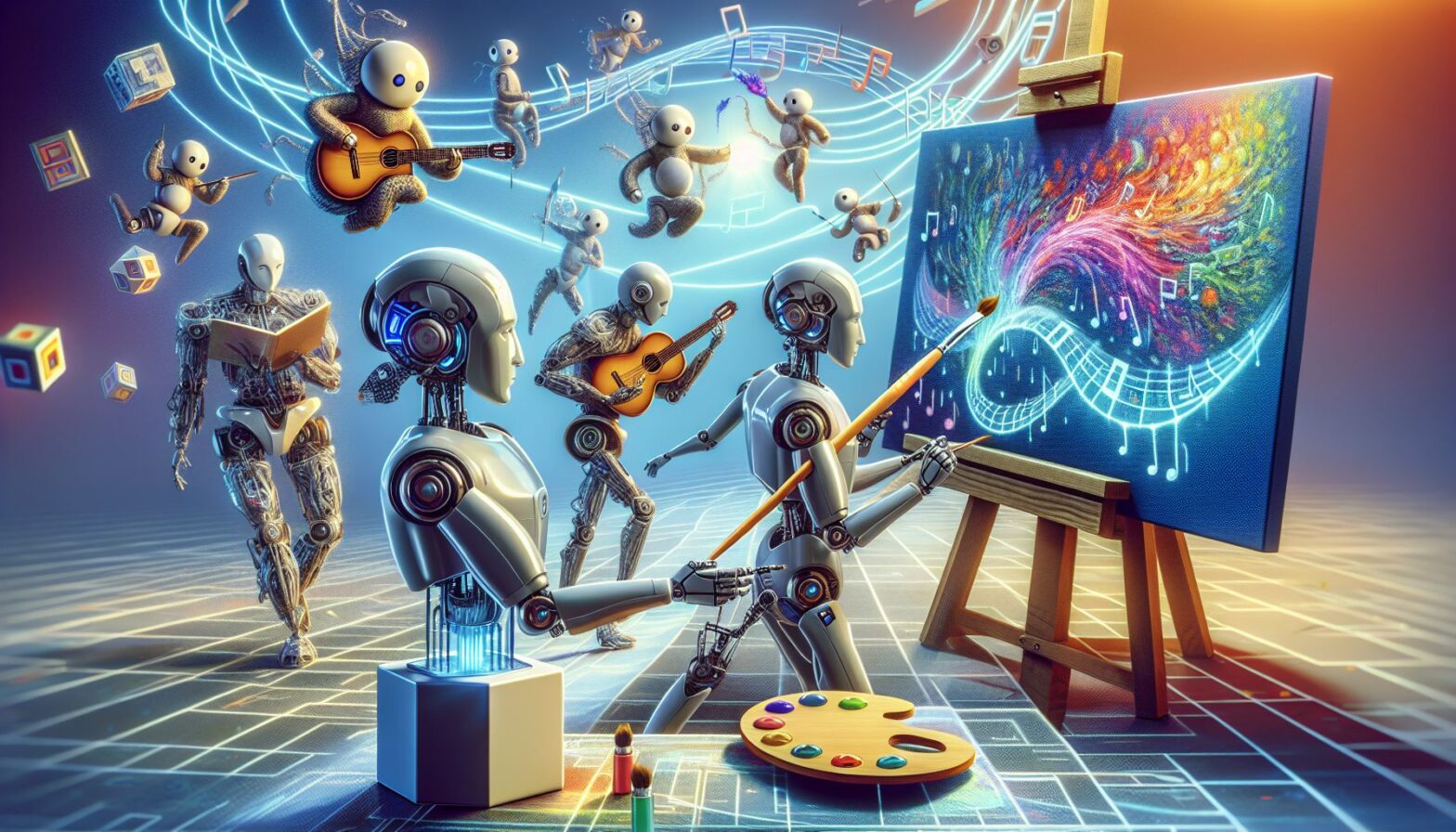
Hey tech enthusiasts! Today, we’re diving into the mind-bending, paint-splashing, and note-bending universe where artificial intelligence is not just a tool, but an artist. If you’re picturing robots with berets holding paintbrushes or AI DJ robots spinning tracks at tomorrow’s raves, you’re not far off. The way AI is blending into the creative arts is honestly pretty wild, so grab your metaphoric paintbrush, and let’s explore this chaotic art-scape.
AI: The Unlikely Muse
Remember the days when art was all about the human touch? The strokes of Van Gogh or the notes of Mozart? Well, fast forward to today, and we’ve got AI entering the art scene like an unexpected guest at a dinner party. One that’s surprisingly charming and weirdly good at dance-offs. From composing symphonies to painting masterpieces, AI’s influence is changing how we think about creativity.
Paint by Numbers? More Like Paint by Algorithms
Let’s start with one of the art forms that most defines traditional creativity: painting. Companies like DeepArt and RunwayML have developed neural network models capable of analyzing various art styles and, believe it or not, applying them to any image you supply. That’s right. Your holiday sunset snap can transform into a Picasso-like cubist masterpiece with just a couple of clicks. Suddenly, everyone’s a potential Van Gogh, minus the bit about losing an ear in the process.
Now, does this mean AI is churning out something novel? Sure, the machine hasn’t had a mid-life crisis or experienced the emotional trauma to pour onto the canvas, but the results can evoke real emotion. Just look at Edmond de Belamy, the AI-generated portrait that sold for nearly half a million dollars at Christie’s in 2018. I mean, there are folks who’d gladly swap some of their old textbooks for that kind of art return.
Composing the Future: AI in Music
Next up, music! Ah, the sweet, sweet symphony of ones and zeroes. Music has always been deeply personal and profoundly human, but with AI’s intervention, the tuneful tides are changing. OpenAI’s MuseNet and Google’s Magenta are just a couple of the platforms out there appealing to budding and experienced musicians alike. These systems use machine learning to create original compositions that are, frankly, often hard to tell apart from human-made pieces. It’s like having a jam session with a tireless partner who never hits a wrong note.
But what does it mean for human creators? Are we being effortlessly muscled out? Not quite. I see it as humans and AI putting their heads together like Lennon and McCartney, but instead, it’s humanity and hardware. AI can handle the technical scaffolding, leaving musicians and composers to do what they do best: infuse heart and soul into their creations. The creative playground is expanding, and we’ve now got more swings, slides, and those little rocking horses than ever before.
Potential Challenges: From Artistry to Artificiality?
Of course, like any juicy plot twist, there are a few clouds in this AI-art paradise. The big question lingers: can something designed and coded by humans really create something as genuinely emotive as a human can? And what do we make of authorship when a machine spits out something uniquely beautiful? It’s like asking if a baker owns the bread or if the yeast gets some credit.
Regulation and copyright trends are still catching their breath while sprinting to keep up. Is the output a product of the coder’s creativity or that of the AI itself? Until the legalities and formalities are sorted, the art world remains a bit of the Wild West. Only instead of tumbleweeds, we have holographic art installations.
And then there’s the ethical side of AI in arts, a philosophical debate waiting to go down Spielberg-style at a TED Talk near you. As AI continues to paint, compose, and sculpt, it raises questions about authenticity, identity, and, most personally, the role of human creativity in the future.
Looking Forward: A Colorful Kaleidoscope of Possibilities
Speculating about the future of AI and creative arts is like trying to predict your next favorite song. It’s about the journey, not just the chorus. As AI becomes more embedded in arts and design, we’ll likely see a fusion of styles and expressions we can hardly imagine today. Picture installations that respond to your emotion, canvases that evolve over time, and symphonies that adapt as you listen. We’re on the brink of a new Renaissance driven by 1s and 0s.
But for now, I’m going to sit and ponder about the AI DJ at my tech-utopian wedding playlist. Who knows, perhaps the first dance song will be an AI original, leaving us to muse if real love can be computed or simply felt.
In wrapping up, I’m thrilled to see where we’ll go as we blend our collective humanity with the unprecedented power of AI. As we tread further into this enchanting territory, remember, art is about perspective. Whether it’s crafted by human hands or digital neurons, it’s about making us feel something. And if AI gets us there too, then bring on the future, paintbrush, baton, or turntable in hand.
Catch you on the flip side, folks! Stay creative and may your GIFs always be animated.